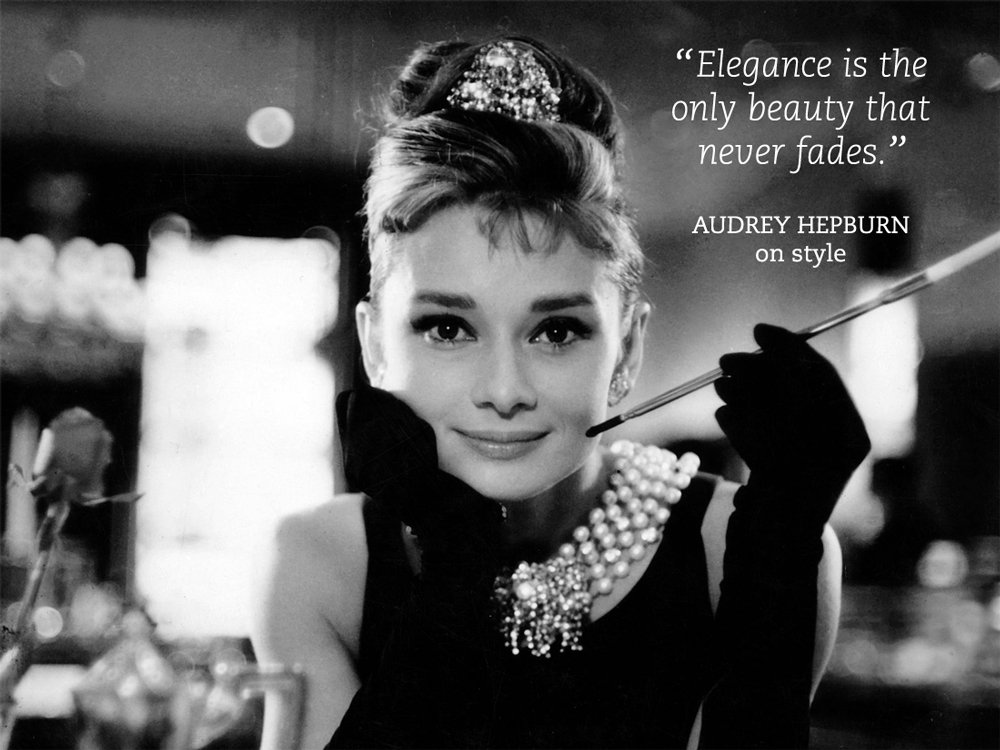
“Why change? Everyone has his own style. When you have found it, you should stick to it.”
On the impossible
“Nothing is impossible, the word itself says ‘I’m possible’!”
On caring
“As you grow older, you will discover that you have two hands, one for helping yourself, the other for helping others.”
“When you have nobody you can make a cup of tea for, when nobody needs you, that’s when I think life is over.”
On life
“Living is like tearing through a museum. Not until later do you really start absorbing what you saw, thinking about it, looking it up in a book, and remembering – because you can’t take it in all at once.”
“There is one difference between a long life and a great dinner; in the dinner, the sweet things come last.”
On marriage
“If I get married, I want to be very married.”
On sex appeal
“There is more to sex appeal than just measurements. I don’t need a bedroom to prove my womanliness. I can convey just as much sex appeal picking apples off a tree or standing in the rain.”
From left: Larry Pine, Tony Revolori, and Owen Wilson, in “The Grand Budapest Hotel.”CREDITPHOTOGRAPH COURTESY MARTIN SCALI / FOX SEARCHLIGHT PICTURES
There are years in which the list fills itself up to the mid-twenties or more. This year, I had to cut it down, arbitrarily, to thirty. Many of the movies on the list fall into the category of “independent” films—in the strict sense of “independent,” rather than in the sense in which it’s commonly applied today.
Classic independent films were low-budget productions made by outsiders. Now most movies that aren’t franchise films have independent producers, and most director-driven projects (including high-budget ones, such as “The Wolf of Wall Street”) are backed by independent financiers, not by studios. That’s why many of the Oscarizables—the movies getting honors from the critics groups that have so far voted (in New York, L.A., Boston, and online)—overlap with the nominations and results of the Gotham Independent Film Awards. These Oscarizable movies are nominally independent films made by directors and actors who have long been Hollywood insiders.
The great surge in American filmmaking in the past ten years is due to independent financing at all levels. The American independent cinema is right now the flower of the world, but independence isn’t in itself a merit badge. Artistically, the films in question range from the majestic to the meretricious. Independent financing has set truly imaginative directors into free flight. This is a moment of extraordinary cinematic invention—of filmmakers, working at a wide range of budget levels, coming up with original and personal ideas about movies and how to make them. On the other hand, this independent surge has also created a new class of culturally respectable directors and films, an ostensible art cinema that flows into the mainstream.
More of the year in review.
True independent filmmaking has always been a tough proposition in the marketplace, let alone at the multiplex. Its commercial obstacles are an increasing problem even for established professionals, who now take their place alongside street-level independents. Filmmakers rightly worry that it’s becoming more difficult than ever to make a salable movie, to make a living making movies. If films are becoming like books, where the artistically ambitious ones are only rarely big hits, then directors working outside Hollywood will become more and more like novelists, who often need to supplement their income with teaching or other outside jobs. As independent films become increasingly marginalized in the marketplace, this loss of status risks marginalizing critics as well—which is why the re-professionalization of the movie business has become a matter of critical advocacy.
At the exact moment in which filmmaking of an astonishing originality and audacity is turning up with surprising frequency, there’s also a dismaying nostalgia sweeping through the critical community (and, with social media making the connections and accelerating the discussions, it does seem like a community). This nostalgia comes to the fore, around year’s end, with the lists—a nostalgia for professionalism, for the ostensibly well-made film, for the film that flaunts a political opinion or a literary pedigree. The celebration of simulacra of old-style craft and the assertion of cinema’s crucial value to the commonweal are at the same time assertions of the importance of critics. Why are critics devoted to craft? Because it takes their knowledge to recognize it. Why to genres? Because it takes their knowledge to trace their evolution. Why to politics? In order to claim the importance of critics—and, incidentally, of movies—to everyone, movie lover or not.
Though criticism, like filmmaking, is in many ways better than ever these days, there’s a decadent version of both, which takes a particular and revealing form. With a few noteworthy exceptions, the European cinema is becoming increasingly complacent, a living museum of cultural values and national pride. (That national pride is expressed not with an air of self-congratulation but with historical self-examination—but not too much self-examination, just enough, done tactfully and tastefully.) And this is happening under the influence of the American cinema. Formerly, that meant Hollywood, and much of international art cinema was a stylistic resistance to American influence.
While Hollywood used to signify a spectacular vulgarity, the influential American cinema now has a stifling and well-meaning tastefulness. It features conspicuously well-mannered cinematography and theatrically by-the-number acting. The movies are full of ruefully thoughtful contemplation and exact determinations of character traits that are ready to be extrapolated from minutely calibrated dialogue and action. It’s no longer Hollywood that spreads its styles around the world; it’s now off-Hollywood, the safe independent cinema and its award winners. The homogenized international style runs from Sundance around the world. The patron saint of the new world cinema is John Sayles, but without his purity, clarity, and ardent sense of purpose.
Even so, there’s a vigorous classicism at work in the most accomplished recent independent films, an authentic continuity between masterworks of the high-studio age and those of this year—and it isn’t in the reheating of traditional genres with old techniques and new sociological spices. The continuity from the classic to the modern is based on the fact that the classical was, in its time, modern: the freely expressive and symbolically dense realism of such Hollywood heroes as Howard Hawks, Vincente Minnelli, Nicholas Ray, Otto Preminger, Douglas Sirk, and Ernst Lubitsch finds its current-day counterpart in films by such directors as Josephine Decker, Joe Swanberg, Alex Ross Perry, Nathan Silver, Eliza Hittman, and Tim Sutton, with relays from the likes of James Gray, David Fincher, and Wes Anderson, and guiding light from such enduring luminaries as Jean-Luc Godard and the late Alain Resnais.
These filmmakers have uninhibited confidence in the power of the image, which is why they can knock it about and work it over with such uninhibited vigor. They shatter the realistic, dramatic image with operatic fury, implode it with frozen stillness, accelerate it with hallucinatory frenzy, overwhelm it with obsessional multiplicity, submerge it with mythological anguish. They are creators of the image who risk the image, creators of experience who provoke the very notion of experience, creators of worlds who fill them with divergences rather than unities, questions rather than verities. The films on this years’s list are—in spirit, in flair, in audacity—akin to their studio predecessors, which, for their part, looked not back but ahead.
P.S.: There were, I estimate, around six hundred new releases in 2014, therefore always more to see. I hope that the weeks to come will offer reasons to return to this list with a follow-up regarding nice things that I missed.
“One Day Pina Asked … ” (Chantal Akerman), which was released here this year but is from 1983; it would be eleventh in the top ten.
Best Actress: Marion Cotillard, “The Immigrant”; Gina Piersanti, “It Felt Like Love”; Brandy Burre, “Actress”; Emma Stone, “Magic in the Moonlight”; Rosamund Pike, “Gone Girl”
Best Actor: Ben Affleck, “Gone Girl”; Bradley Cooper, “American Sniper”; Benicio Del Toro, “Jimmy P.”; Jason Schwartzman, “Listen Up Philip”; Willis Earl Beal, “Memphis”; Vicenç Altaió, “Story of My Death”
Best Supporting Actress: Elisabeth Moss, “Listen Up Philip”; Sienna Miller, “American Sniper”; Giovanna Salimeni, “It Felt Like Love”; Reese Witherspoon, “Inherent Vice”
Best Supporting Actor: Robert Longstreet, “Thou Wast Mild and Lovely”; Joaquin Phoenix, “The Immigrant”; Theodore Bouloukos, “Soft in the Head”; Tony Revolori, “The Grand Budapest Hotel”
Best Cinematography: Ashley Connor, “Thou Wast Mild and Lovely” and “Butter on the Latch”; Sean Price Williams, “Listen Up Philip”; Fabrice Aragno, “Goodbye to Language”; Darius Khondji, “The Immigrant” and “Magic in the Moonlight”; Willy Kurant, “Jealousy”; Claire Mathon, “Stranger by the Lake”
Best Undistributed Films:
“Hill of Freedom” (Hong Sang-soo)
“Heaven Knows What” (Josh & Benny Safdie)
“Da Sweet Blood of Jesus” (Spike Lee)
“The Princess of France” (Matías Piñeiro)
“Journey to the West” (Tsai Ming-liang)
“Uncertain Terms” (Nathan Silver)
“For the Plasma” (Bingham Bryant & Kyle Molzan)
“Wild Canaries” (Lawrence Michael Levine)
“Jauja” (Lisandro Alonso)
“Young Bodies Heal Quickly” (Andrew T. Betzer)
“La Fille du 14 Juillet” (“The Rendez-Vous of Déjà Vu”) (Antonin Peretjatko)
“Tonnerre” (Guillaume Brac)
“La Bataille de Solférino” (“Age of Panic”) (Justine Triet)
And there’s still a backlog of unreleased films by Hong Sang-soo, including “Nobody’s Daughter Haewon” and “Our Sunhi”
And the trailer for “Gaby Baby Doll” (Sophie Letourneur), which opens in France on December 17th, leaves something to anticipate eagerly.
The Negative Ten: Not the worst films of the year (far from it—some of these movies have significant merit) but the ones that occlude the view toward the year’s most accomplished and daringly original work; I mention them here to clear the field.
Richard Brody began writing for The New Yorker in 1999, and has contributed articles about the directors François Truffaut, Jean-Luc Godard, and Samuel Fuller. He writes about movies in his blog for newyorker.com.