레이블이 cinema인 게시물을 표시합니다. 모든 게시물 표시

2015년 4월 1일 수요일

[BFI] Audrey Hepburn quotes

Audrey Hepburn quotes

Wit and wisdom from the irreplaceable star of Roman Holiday, Breakfast at Tiffany’s and My Fair Lady.
1 May 2014
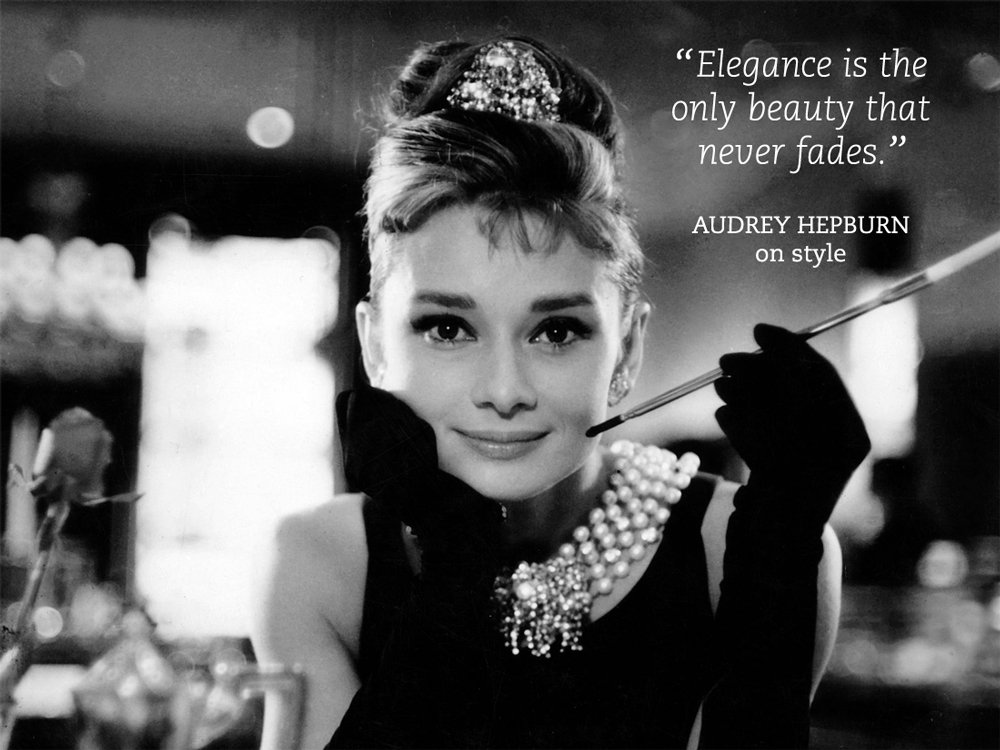
Breakfast at Tiffany's (1961)
On style
“Elegance is the only beauty that never fades.”
“Why change? Everyone has his own style. When you have found it, you should stick to it.”
On the impossible
“Nothing is impossible, the word itself says ‘I’m possible’!”
On caring
“As you grow older, you will discover that you have two hands, one for helping yourself, the other for helping others.”
“When you have nobody you can make a cup of tea for, when nobody needs you, that’s when I think life is over.”
On life
“Living is like tearing through a museum. Not until later do you really start absorbing what you saw, thinking about it, looking it up in a book, and remembering – because you can’t take it in all at once.”
“There is one difference between a long life and a great dinner; in the dinner, the sweet things come last.”
On marriage
“If I get married, I want to be very married.”
On sex appeal
“There is more to sex appeal than just measurements. I don’t need a bedroom to prove my womanliness. I can convey just as much sex appeal picking apples off a tree or standing in the rain.”
On friendship
“True friends are families which you can select.”

2014년 3월 19일 수요일

The top movies of 2013

Top 20 2013 des lecteurs des Cahiers (top 20 2013 by Cahiers du cinéma's readers) 1. La Vie d'Adèle d'Abdellatif Kechiche 2. L'Inconnu du lac d'Alain Guiraudie 3. Spring Breakers de Harmony Korine 4. Gravity d'Alfonso Cuarón 5. Django Unchained de Quentin Tarantino 6. Inside Llewyn Davis d'Ethan et Joel Coen 7. Mud de Jeff Nichols 8. A Touch of Sin de Jia Zhang-ke 9. Frances Ha de Noah Baumbach 10. The Master de Paul Thomas Anderson 11. La Vénus à la fourrure de Roman Polanski 12. Lincoln de Steven Spielberg 13. Camille Claudel 1915 de Bruno Dumont 14. Passion de Brian de Palma 15. La Jalousie de Philippe Garrel 16. Shokuzai de Kiyoshi Kurosawa 17. La Bataille de Solférino de Justine Triet 18. La Fille du 14 juillet d'Antonin Peretjatko 19. Le Congrès d'Ari Folman 20. Haewon et les hommes de Hong Sang-soo -- CNN readers' favorite movies of 2013 1.The Hunger Games: Catching Fire 2. Star Trek Into Darkness 3. Gravity 4. Iron Man 3 5. Thor: The Dark World 6. Despicable Me 2 7. Man of Steel 8. Fast & Furious 6 9. Monsters University 10. 12 Years a Slave -- Top 10 movies of 2013 selected by TIME 1. Gravity 2. The Great Beauty 3. American Hustle 4. Her 5. The Grandmaster 6. Fast & Furious 6 7. Frozen 8. The Act of Killing 9. 12 Years a Slave 10. The Hobbit: The Desolation of Smaug

2013년 12월 5일 목요일

[BBC Culture] The silver screen’s silver-hair boom By Nicholas Barber


It has nothing to do with flowers, but there is a new phenomenon in the film industry known as the Marigold Effect. It refers to a resurgent interest in characters who are, shall we say, a year or two older than the typical action-movie hunk or romantic-comedy babe. It stems from  the colossal success of The Best Exotic Marigold Hotel in 2012. The stars of that film, including Judi Dench, Maggie Smith and Bill Nighy, are all in their sixties and seventies, a factor that was enough to stop several studios investing in it. And yet the low-budget British film went on to make £85m ($137m) at the global box office − proof that a few wrinkles and grey hairs could attract viewers, rather than put them off. One of the beneficiaries of this proof was Philomena, a new true-life comedy drama about a retired Irish nurse (Judi Dench) seeking the son who was taken from her as a baby by Catholic nuns.
“The truth is,” says Gabrielle Tana, one of the film’s producers, “when we cast Judi Dench in Philomena we could all of a sudden quote the Marigold Effect. That’s not why we made the film, of course. We did it because we had a wonderful story to tell. But it was a blessing that Marigold was already there.”
Nor was The Best Exotic Marigold Hotel the only one of 2012’s releases to demonstrate the money-spinning potential of senior citizens. In the same year, Meryl Streep and Tommy Lee Jones discussed their sex life in Hope Springs, and Michael Haneke won the Palme d’Or at Cannes for Amour, his tragic account of an elderly Parisian husband and wife being pulled apart by illness. In 2013, the trend continued with Dustin Hoffman’s Quartet and Alexander Payne’s Nebraska, and it has been announced that The Best Exotic Marigold Hotel itself is going to have a sequel.
Also on the list is Le Week-End, featuring James Broadbent and Lindsay Duncan as an English couple celebrating their 30th wedding anniversary in Paris. It is the third film with pensionable protagonists to come from the team of Roger Michell, its director, Hanif Kureishi, its writer, and Kevin Loader, its producer. Their previous collaboration was Venus, starring Peter O’Toole and Leslie Phillips, and before that was The Mother, a drama that explored an affair between a sexagenarian woman (Anne Reid) and a much younger handyman (Daniel Craig). “In 2003,” chuckles Loader, “The Mother seemed a very radical thing to be doing. Now here we are ten years later and we seem to be part of a movement!”
A golden age
Loader credits this movement, in part, to the wealth of actors-of-a-certain-age who aren’t willing to leave the stage just yet. “There’s a brilliant generation of actors who want to keep working and are really loving the opportunity to do this kind of material,” he says. “They’re not being offered these parts in mainstream movies, so if you write interesting roles you can get very distinguished actors to come and work in your very low-budget film.”
But the 60 and 70 somethings who are queuing up to star in challenging films are only half the story. What is just as significant is the people of a similar age who are queuing up to watch them. Or, as Loader puts it, “It’s down to the open mindedness of a generation that now has a bit of time on its hands.” This baby-boomer generation, which can remember the grown-up cinema of the 1960s and 1970s, was driven away by the subsequent barrage of superhero movies, but it is now being lured back by more earthbound, character-led dramas. “There was a huge gap in terms of what was available,” says Tana. “The entertainment industry is all about tentpole blockbusters and teenagers now, but The Best Exotic Marigold Hotel showed that there was this undernourished, under-served, older audience out there.”
In fact, that audience was already being enticed back to cinemas. In 2008, Mamma Mia! may have put Amanda Seyfried on its posters, but the film itself focused on Meryl Streep’s late middle-aged heroine − and it went onto make £377m ($610m). Two years on, another film had a similar impact. “Anecdotally, The King’s Speech had a hugely beneficial effect,” says Charles Gant, The Guardian’s  box-office expert. “Older audience members who hadn’t been to the cinema in decades were amazed to discover that a) cinemas are nicer now than when they were smoky fleapits, and b) there are intelligent films for them to enjoy. I have lots of friends who tell me their parents go to the cinema a couple of times per year since The King’s Speech, whereas prior to that it had been years since they had been.”
Technology is also helping to pack movie theatres with older audiences. If cinemas have become more comfortable in recent years, the way in which films are transported to these cinemas has been modernised, too. Now that the latest releases can be distributed digitally, there is no need for anyone to cart around or store bulky canisters of celluloid. As a result, it’s easier for cinemas to hang onto as many films as they like for as long as they like, which means that they can be more flexible with their scheduling. “Older audiences don’t necessarily find a film the first weekend it’s out,” says Loader. “It can take them a few weeks, so it’s important for these films to stay around longer. That used to be complicated, but with digital distribution it’s not that difficult for independent cinemas and enlightened multiplexes to have a drama playing on the smaller screens during the week, when pensioners can go and see them, and then they can put the blockbusters on at the weekend. It’s always been an odd idea to build these massive cinemas, and have them full all weekend and empty during the week. The managers are slowly waking up to the fact that older audiences will fill them up on Mondays to Thursdays.”
And if there is money to be made by films that are for and about older people, it is hardly surprising that Hollywood’s executives are waking up, too. Two of this year’s American offerings are Last Vegas, which sends Robert De Niro, Michael Douglas, Morgan Freeman and Kevin Kline on a stag trip together, and Escape Plan, which teams up Sylvester Stallone and Arnold Schwarzenegger. The average age of these stars is 69 − a sure sign that even the mighty Schwarzenegger can be influenced by Judi Dench and The Marigold Effect.
If you would like to comment on this story or anything else you have seen on BBC Culture, head over to our Facebook page or message us on Twitter.
2013년 11월 19일 화요일

[Little White Lies] 15 Films To See At The BFI London Film Festival 2013

Only Lovers Left Alive (Jim Jarmusch) – Cult

Directed by Jim Jarmusch, this love story between vampires Tilda Swinton and Tom Hiddleston is what would play if there was an indie heaven, projected inside a giant coffin made of upcycled lace. Expect gothic imagery, grand emotion, genre riffing and an offbeat tone. The translucent and talented Mia Wasikowska is in the mix as a sisterly spanner in the works.

12 Years A Slave (Steve McQueen)

The third collaboration between director Steve McQueen and his star Michael Fassbender sounds as ambitious as Hunger andShame while also treading new storytelling ground. Fassbender plays the villainous plantation boss Epps, Chiwetel Ejiofor stars as Solomon, a slave struggling for dignity. McQueen regulars DoP Sean Bobbitt and editor Joe Walker are present to ensure a visually engaging ride.

We Are The Best! (Lukas Moodysson) –  Sonic

Swede Lukas Moodysson has had a curious career. Emerging 15 years with the smalltown comic delight Show Me Love he was hailed as the new Ingmar Bergman before disappearing into a cinematic no-man’s land. Early buzz around We Are The Best!suggests this coming-of-ager about two punk-loving adolescents in the ‘80s is return to what Moodysson does best.

The Double (Richard Ayoade)

Richard Ayoade’s second feature film is about a man driven wild by a doppelganger. Jesse Eisenberg plays Simon, a downtrodden office clerk besotted by colleague Hannah (Mia Wasikowska). A descent into madness is prompted by the appearance of a confident and successful double. Adapted from a Dosteyevsky novella, we’re expecting endearing, Submarine-like touches to find their way into this psychologically fearsome premise.

Under The Skin (Jonathan Glazer)

Scarlett Johansson plays an alien femme fatale in this adaptation of Michel Faber’s eerie and humanity-hating sci-fi novel. With Birth director Jonathan Glazer at the helm, its Glasgow setting never seemed so grim. Under the Skin has been bowling over all at Venice even as critics struggle to pierce the heart of this strange and haunting story. Read our review from the 2013 Venice Film Festival.

Tom At The Farm (Xavier Dolan)

Precocious 24-year-old French-Canadian Xavier Dolan has been very busy since he made his name with Heartbeats in 2010. Hipster soundtracks, stylised cinematography and self-casting ( you would if you looked like the male Helen of Troy) have divided audiences but early word on Tom at the Farm is this taut relationship drama dealing with sexuality will impress beyond Dolan’s usual (adoring) fanbase. Read our review from the 2013 Venice Film Festival.

The Armstrong Lie (Alex Gibney)

Alex Gibney is rapidly emerging as the most important documentarian of his generation, shedding light wherever there is murk. His muscular investigative style is brought to cycling superstar turned dope-scandalee, Lance Armstrong. Expect great access, clear storylines and a forceful drive towards truth.

Exhibition (Joanna Hogg) –  Dare

We do so love the well-observed civil awkwardness of Joanna Hogg's previous films, Unrelated and Archipelago. Long shots, stilted dialogue and a pathetic desire to stay polite even as sucked down by emotions are her calling cards. This third time round, Tom Hiddleston (Hogg’s good friend and regular collaborator) is in a supporting role while Viv Albertine and Liam Gillick play the lead artist couple dealing with the domestic furore of selling the house.

Half A Yellow Sun (Biyi Bandele) – Dare

Chimamanda Ngozi Adichie won the Orange Prize for Fiction with his 2006 novel about two sisters, Olanna and Kainen, trying to live a full life on the cusp of the Nigerian Civil War of the '60s. With Thandi Newton playing Olanna and Chiwetel Ejiofor (hi again) as her husband, Odenigbo, this adap promises to bring the war of a flailing relationship to the fore just as much as the actual impending war.

Locke (Steven Knight) –  Journey

Would you like to be locked in a car with Tom Hardy for 90 minutes? It's not for everyone, but The Hard man’s performance has been praised to the hilt in this single character study of a life unraveling across the length of a car journey.

Enough Said (Nicole Holofcener) – Laugh

Sadness rocked the industry in June when it was announced that James Gandolfini died of a heart attack at the age of 51. Enough Said was his penultimate film (Animal Rescue, out next year, was his last) and he’s got serious female acting cahoonas keeping him company. Julia Louis-Dreyfus, Catherine Keener and Toni Colette help to rock this mid-life-crisis rom-com.

Gone Too Far (Destiny Ekharaga) – Laugh

British/Nigerian comedian/director Destiny Ekharaga is one to watch according to festival programmer, Clare Stewart. Her first feature is a comedy set over the course of a single day in Peckham, south London. Family, loyalty and race are among the themes.

La Belle et la Bête (Jean Cocteau) – Love

At last year’s LFF, David Lean’s four hour masterpiece, Lawrence of Arabia was among the highlights. This year’s archival treasure of note is a restoration of Jean Cocteau’s 1946 gothic love story.

Norte, The End of History (Lav Diaz) –  Dare

Filipino auteur Lav Diaz favours epics, meaning this sub four-hour drama is the perfect (comparatively) tame entry point for the uninitiated. Loosely based on Dostoevsky’s (hi again) classic 1886 novel, 'Crime and Punishment', Diaz transplants the action to the Philipines where lush imagery takes the place of bleak Russian streets.

The Congress (Ari Folman) –  Cult

This follow-up to Waltz With Bashir takes on the revealing subject of ageing from the perspective of a Hollywood actress. Robin Wright plays... Robin Wright, who sells her digitised image to Miramount Studios. Blending live action and animation, The Congress looks like it could take satire to a whole new form-pushing plain.
For more information on the 57th LFF and to book tickets visit bfi.org.uk/lff

[the Guardian] Swedish cinemas take aim at gender bias with Bechdel test rating

Swedish cinemas take aim at gender bias with Bechdel test rating

Movies need to pass test that gauges the active presence of women on screen in bid to promote gender equality
Jennifer Lawrence as Katniss Everdeen in The Hunger Games
Jennifer Lawrence as Katniss Everdeen in The Hunger Games, a film that would pass the Bechdel test and gain an A rating. Photograph: Murray Close
You expect movie ratings to tell you whether a film contains nudity, sex, profanity or violence. Now cinemas in Sweden are introducing a new rating to highlight gender bias, or rather the absence of it.
To get an A rating, a movie must pass the so-called Bechdel test, which means it must have at least two named female characters who talk to each other about something other than a man.
"The entire Lord of the Rings trilogy, all Star Wars movies, The Social Network, Pulp Fiction and all but one of the Harry Potter movies fail this test," said Ellen Tejle, the director of Bio Rio, an art-house cinema in Stockholm's trendy Södermalm district.
Bio Rio is one of four Swedish cinemas that launched the new rating last month to draw attention to how few movies pass the Bechdel test. Most filmgoers have reacted positively to the initiative. "For some people it has been an eye-opener," said Tejle.
Beliefs about women's roles in society are influenced by the fact that movie watchers rarely see "a female superhero or a female professor or person who makes it through exciting challenges and masters them", Tejle said, noting that the rating doesn't say anything about the quality of the film. "The goal is to see more female stories and perspectives on cinema screens," he added.
The state-funded Swedish Film Institute supports the initiative, which is starting to catch on. Scandinavian cable TV channel Viasat Film says it will start using the ratings in its film reviews and has scheduled an A-rated "Super Sunday" on 17 November, when it will show only films that pass the test, such as The Hunger Games, The Iron Lady and Savages.
The Bechdel test got its name from American cartoonist Alison Bechdel, who introduced the concept in her comic strip Dykes to Watch Out For in 1985. It has been discussed among feminists and film critics since then, but Tejle hopes the A rating system will help spread awareness among moviegoers about how women are portrayed in films.
In Bio Rio's wood-panelled lobby, students Nikolaj Gula and Vincent Fremont acknowledged that most of their favourite films probably would not get an A rating.
"I guess it does make sense, but to me it would not influence the way I watch films because I'm not so aware about these questions," said Fremont, 29.
The A rating is the latest Swedish move to promote gender equality by addressing how women are portrayed in the public sphere.
Sweden's advertising ombudsman watches out for sexism in that industry and reprimands companies seen as reinforcing gender stereotypes, for example by including skimpily clad women in their adverts for no apparent reason.
Since 2010, the Equalisters project has been trying to boost the number of women appearing as expert commentators in Swedish media through a Facebook page with 44,000 followers. The project has recently expanded to Finland, Norway and Italy.
For some, though, Sweden's focus on gender equality has gone too far.
"If they want different kind of movies they should produce some themselves and not just point fingers at other people," said Tanja Bergkvist, a physicist who writes a blog about Sweden's "gender madness".
The A rating has also been criticised as a blunt tool that does not reveal whether a movie is gender-balanced.
"There are far too many films that pass the Bechdel test that don't help at all in making society more equal or better, and lots of films that don't pass the test but are fantastic at those things," said Swedish film critic Hynek Pallas.
Pallas also criticised the state-funded Swedish Film Institute – the biggest financier of Swedish film – for vocally supporting the project, saying a state institution should not "send out signals about what one should or shouldn't include in a movie".
Research in the US supports the notion that women are under-represented on the screen and that little has changed in the past 60 years.
Of the top 100 US films in 2011, women accounted for 33% of all characters and only 11% of the protagonists, according to a study by the San Diego-based Centre for the Study of Women in Television and Film.
Another study, by the Annenberg Public Policy Centre at the University of Pennsylvania, showed that the ratio of male to female characters in movies has remained at about two to one for at least six decades. That study, which examined 855 top box-office films from 1950-2006, showed female characters were twice as likely to be seen in explicit sexual scenes as males, while male characters were more likely to be seen as violent.
"Apparently Hollywood thinks that films with male characters will do better at the box office. It is also the case that most of the aspects of movie-making – writing, production, direction, and so on – are dominated by men, and so it is not a surprise that the stories we see are those that tend to revolve around men," Amy Bleakley, the study's lead author, said in an email.